
Learning Designer |
Accessibility-First Learning Design| AI-Supported Workflows
Skye’s Instructional Design Portfolio

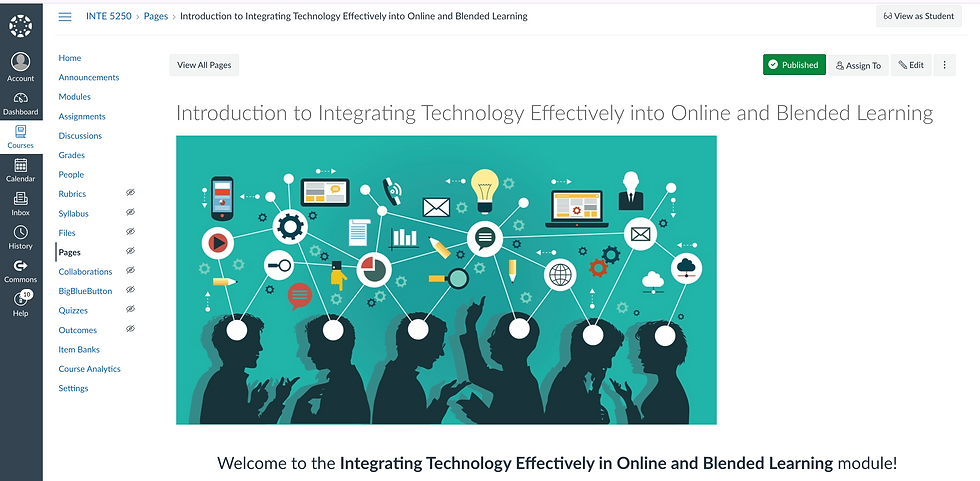
Integrating Technology Effectively in Online & Blended Learning
This project was a collaborative Canvas module designed to support instructors and learning designers in selecting and integrating educational technologies effectively in online and blended learning environments.
The module focuses on helping professionals make intentional, pedagogically aligned technology decisions, rather than selecting tools based on trends or convenience.
Tools Used
Canvas LMS | Discussion-Based Learning | Scenario Design | Google Docs & Slides | AI-Supported Workflows
Category
Educational Technology Strategy
My Role
Learning Designer | Facilitator | Content Developer
As part of a collaborative team, I contributed to:
• Module structure and instructional design
• Development of learning activities and discussion prompts
• Facilitation of learner engagement and feedback
• Integration of accessibility and inclusive design practices
I also participated in reviewing and responding to learner discussions to support engagement and reflection.
Testimonials & Feedback
Testimonials include feedback from clients, instructors, and peers across both professional and academic projects.
“This project is very well-organized, with a thorough analysis of learners that clearly informed key design decisions. The module provides a clear and flexible navigation structure, allowing learners to engage based on their own background and interests. It also demonstrates strong integration of the Community of Inquiry framework, the Absorb-Do-Connect approach, and Universal Design for Learning (UDL) principles and inclusive practices.”
- Jill Giacomini, Instructor
The Challenge
Many instructors struggle with:
• Choosing appropriate technologies for their learning goals
• Balancing innovation with usability and accessibility
• Evaluating tools beyond surface-level features
The challenge was to design a module that helped learners:
✔ Make informed technology decisions
✔ Connect tools to pedagogy
✔ Apply learning to real-world teaching contexts
Evidence of Impact
• Strengthened decision-making skills by guiding learners through structured evaluation of educational technologies
• Bridged theory and practice by applying real-world scenarios across multiple learning environments
• Improved clarity in tool selection by aligning choices with pedagogical goals, not just features
• Used AI to assist with organizing and synthesizing complex information while maintaining instructional intent
Design Approach
The module was designed using a practice-based, scenario-driven approach:
• Learners explored curated readings and resources
• Engaged in real-world scenarios (K-12, Higher Ed, Professional Learning)
• Selected and evaluated technologies based on instructional goals
• Participated in peer discussion and reflection
The structure followed Horton’s Absorb–Do–Connect model:
• Absorb: Readings and videos on edtech integration
• Do: Evaluate and select a tool for a given scenario
• Connect: Share and reflect through discussion with peers
Accessibility in Practice
Accessibility and inclusion were embedded through:
• Applying UDL principles (multiple means of engagement, representation, and expression)
• Offering diverse content formats (articles, videos, frameworks)
• Providing learner choice in scenarios and tool selection
• Designing flexible discussion-based responses
• Incorporating tools that support organization and self-regulation
These practices helped ensure the module was usable and relevant across diverse teaching contexts.
AI as a Design Partner
AI was used to support development and refinement of the module.
AI-supported tasks included:
• Refining instructional clarity and language
• Supporting development of scenarios and prompts
• Assisting with organization of content and structure
All outputs were reviewed to ensure alignment with pedagogical goals and accessibility principles.
Key Features
• Scenario-based learning across multiple contexts (K-12, Higher Ed, Professional)
• Discussion-driven learning and peer collaboration
• Application of Horton’s Absorb–Do–Connect model
• Integration of Community of Inquiry framework (social, cognitive, teaching presence)
• Focus on accessibility, cost, and privacy in tool selection
Outcome
The final product is a collaborative, application-focused learning module that:
• Helps educators make informed technology decisions
• Connects instructional tools to learning outcomes
• Encourages reflection and peer learning
• Supports real-world application across disciplines
Reflection
This project reinforced that effective technology integration is not about the tool itself, but about how well it aligns with learning goals and learner needs.
Working in a collaborative design environment also highlighted the importance of:
• Shared decision-making
• Clear communication
• Balancing multiple perspectives
It strengthened my ability to design within a team while maintaining a focus on accessibility and pedagogical alignment.

